
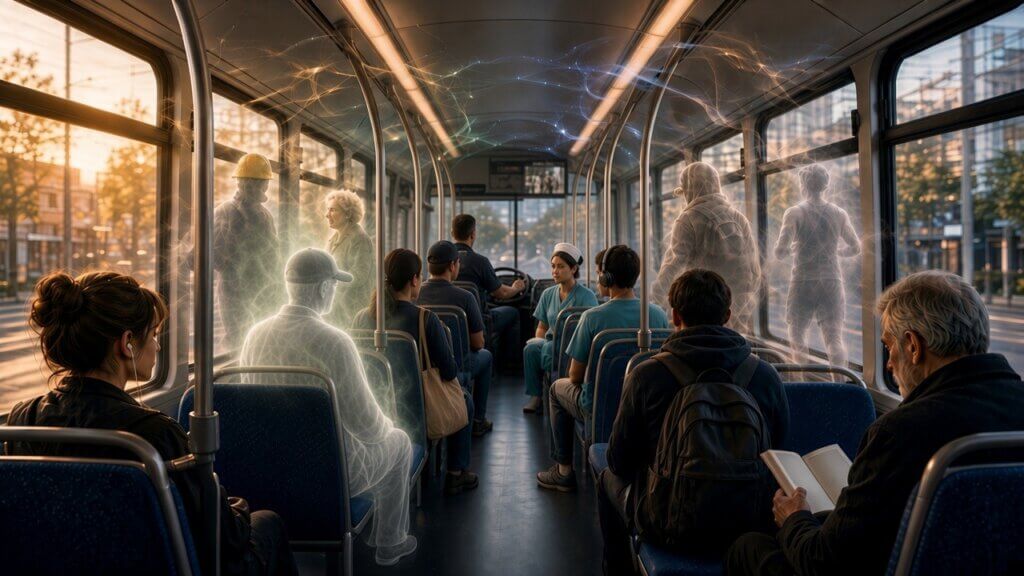
The doors fold open with that soft hydraulic hush, and you step up onto the metal tread. The rail is still warm under your hand. Somewhere mid-cabin, a seat holds the shape of whoever rode the route before you.
Outside: the city, wet pavement, a bus stop with a cracked schedule. Inside: air that has already made a dozen stops, and has not quite decided to leave any of them behind.
You settle into the seat. Before you have found your bag, your nose has already filed the cabin. Smoke that rode three stops ago. Body odor from the morning crush. A wet coat drying on a rail. The last ride did not get off with its passengers. It stayed in the air.
That is not your imagination. Smell arrives in roughly 100 to 150 milliseconds, and the olfactory path skips the long thalamic briefing every other sense has to sit through. It goes straight to emotion and memory. By the time you look for an open seat, the cabin has already told you how the next twenty minutes will feel.
Clear What the Last Ride Left
A transit bus is a shared room that never quite empties. Doors open, doors close, and the air keeps a running ledger of every passenger who breathed it. The first job is not perfume. The first job is clearing what the last ride left hanging: residue, stale recycled air, the thin film of a route that ran before yours. Dry-air technology does this without heat, without water, without the heavy solvents that turn a cabin into a wet fog. Scent molecules move as dry particles, roughly ten nanometers across — not wet droplets that cling to seats and rails. You never notice this step when it is done well. You only notice when it is skipped.
Then the Malodor Goes Quiet
Clean is not the same as quiet. Smoke does not leave when the smoker does. Body odor settles into fabric the way damp settles into a coat. Wet gear brings the outside in and leaves it there. Masking those notes just layers citrus on top of sweat — a bus that smells like a candle store at rush hour. Neutralizing is different. Dry-air cartridges react with the odor molecules themselves and take them down at the molecular level. They do not cover the story. They end it. The rail should smell like a rail. The seat should smell like nothing at all, until the ride gives it something better to hold.
The Cabin Learns the Season
A January commute is not a July one, and neither is the wet November afternoon when every coat comes on dripping. The Digital Scent AI Platform can shift with the calendar the way the city does. Spring: fresh green and light floral. Summer: bright citrus and open air. Fall: warm spice and crisp leaves. Winter: clean pine and cool air. The same dry-air layer can lean functional too — Alert when the morning route needs focus, Calm when the evening run needs to come down, Reset when the cabin needs to start over between stops.
What Floats Between Stops
Shared air carries more than odor. The same dry-air layer can reduce the airborne load passengers pass between them — not as a cure, not as a promise that no one gets sick, only as healthier molecules in a cabin that never stops filling and emptying.
You get off at your stop with the cabin already settling behind you for whoever boards next. The ride felt cleaner. The next conversation starts a little easier. The last ride stayed outside.
Reads You. Adapts to You. Restores You.