



Scent, the Body & Brain, and the Architecture of Digital Scent
By Keith Kelsen
“Compelling reasons for scent systems” -Reader California
“I had no Idea that scent caused my mood to change automatically without me realizing” -Reader in NYC.
“This is AI Science influencing one of the most under rated yet powerful sense we have” -Reader in Silicon Valley
Introduction
A molecule enters the nose and, within a fraction of a second, systems that regulate emotion, memory, heart rate, and arousal have already begun to move. There is no pause for evaluation. No internal committee decides whether the signal is worth processing. The architecture of the olfactory system simply does not wait for permission.
This short e-book is about that architecture—and about what becomes possible when we design for it with intention. It is about the difference between a scent that merely smells pleasant and a scent that performs a function: calming a nervous system, clarifying attention, reducing airborne pathogens, or dismantling the molecular structure of lingering odor so that a shared space can feel newly neutral.
It is also about the technological layer now emerging around scent. For most of human history, fragrance was passive. It was applied, diffused, or encountered by chance or by ritual. Today it can be timed, measured, adapted, and paired with other sensory streams—light, sound, data—so that the short interval between one place and the next becomes a deliberate reset rather than residual stress.
The chapters that follow begin with a brief history of how humans have used and understood scent, move through the fundamental neuroscience of smell and the body’s automatic replies, examine the practical design of functional scent experiences in vehicles and beyond, and then look forward into the intelligent systems that are beginning to treat every breath as information. The through-line is consistent: the body responds first. The opportunity is to meet that response with care, precision, and respect for the systems that operate below the threshold of conscious choice.
This is not a technical manual, though it rests on technical foundations. It is an argument for taking the oldest sense seriously in an age that has largely forgotten how to design for it. When we do, ordinary environments stop being accidental and start becoming instruments of restoration. The pages ahead invite the reader to see the air itself as a medium of care—one that has always been speaking to the body, whether we were listening or not. – Keith Kelsen
Contents
7. Reading, Adapting, Restoring
8. Intelligent Olfactory Environments
1. A Brief History of Scent

From ritual and medicine to chemistry and code
Long before anyone mapped limbic pathways or named olfactory receptors, scent was already doing serious work. In the ancient world it was medicine, religion, status marker, and memory cue all at once. Temples across the Near East, Egypt, India, and China burned resins not only as offerings but as technologies of atmosphere. The smoke cleaned, marked sacred space, and altered the state of those who stood inside it. Egyptian physicians and priests employed aromatic preparations in healing protocols and in the elaborate chemical processes of mummification. Botanical knowledge was recorded, traded, and refined with a seriousness that later centuries would rediscover only slowly.
The practical logic was often sound even when the explanatory models were not. In an era without germ theory, strong pleasant odors were associated with vitality and foul ones with corruption and disease. The association was imperfect, yet it oriented entire cultures toward the active management of air. Perfumes, incense, scented oils, and aromatic waters were atmospheric technologies long before they became luxuries of personal adornment. The same materials that pleased the gods were understood to protect the living.
In ancient Egypt the use of kyphi—a complex incense compound—illustrates how sophisticated early olfactory practice could be. Recipes mixed resins, herbs, honey, and wine into formulations that were burned in temples and used in domestic and medical contexts. The materials were not chosen at random; they were selected for both their aromatic profile and their perceived effects on the body and the spirit. Similar complexity appears in Vedic and later Ayurvedic traditions, where aromatic substances were classified according to their influence on the doshas and were integrated into daily and seasonal routines.
Greek and Roman writers left extensive records of both the pleasures and the powers of scent. Theophrastus, a student of Aristotle, produced one of the earliest systematic treatises on odors and their sources, distinguishing among the qualities of different aromatic materials and noting their effects. Roman elites imported frankincense, myrrh, and other aromatics at extraordinary cost; the trade routes that carried them were arteries of empire as well as of culture. At the same time, the smell of the dense city itself—its markets, drains, workshops, and crowded housing—was a constant reminder that air could not be taken for granted. Public bathing cultures, the widespread use of oils and unguents, and the careful placement of gardens and courtyards were, in part, responses to that olfactory reality.
Through the medieval and early modern periods, scent continued to occupy an ambiguous but important place between medicine, ritual, and social distinction. During plague years, aromatic materials were stuffed into the beaks of protective masks and burned in the streets in the belief that foul air carried disease and that pleasant or pungent smoke could interrupt its spread. The belief was incomplete, yet it kept attention focused on the quality of the air people breathed. Renaissance and Baroque courts developed elaborate etiquette around perfume and the control of bodily odor; to smell a certain way was to signal rank, refinement, and membership in a particular social world. The rise of distillation techniques and the growth of botanical gardens gradually turned fragrance from a matter of rare natural substances into something that could be concentrated, standardized, and eventually synthesized.
The nineteenth and twentieth centuries completed a decisive transformation. Organic chemistry made it possible to isolate the molecules responsible for characteristic smells and then to recreate or invent them in the laboratory. Synthetic aroma chemicals democratized scent on a global scale while also industrializing it. Perfume became a mass-market category available far beyond the circles that had once controlled access to rare natural materials. Simultaneously, the modern city and the modern vehicle introduced new and concentrated olfactory problems: exhaust, industrial emissions, the residual chemistry of shared enclosed spaces. Scent technology responded in two directions at once—toward ever greater refinement of pleasure on the one hand, and toward the practical management of unwanted odor on the other.
What remained underdeveloped until relatively recently was a systematic, evidence-based understanding of how scent acts on the nervous system, together with a technological capacity to deliver it with precision, timing, and adaptation. Traditional aromatherapy preserved rich experiential knowledge of regulatory effects, yet it often stood outside the mainstream of both clinical medicine and product design. Mass-market air fresheners and odor maskers proliferated, but they typically treated the symptom rather than the molecular cause and rarely considered the longer physiological conversation the body was having with the air it breathed. The result was a culture that used scent constantly yet understood it poorly.
The present moment is different. Neuroscience has clarified the privileged pathway from the nose to the limbic system and the autonomic networks. Chemistry has produced both highly targeted functional compositions and methods of altering odor molecules at the structural level. Digital systems now make it possible to time, measure, personalize, and coordinate scent with other environmental variables. History has brought us to a point where the oldest sense can be designed for with a sophistication that earlier centuries could only approximate. The remainder of this book explores what that design can look like in practice—and why it matters for the quality of everyday human experience.
2. The Direct Line

Why scent reaches the brain differently than any other sense
Most of what we call perception is mediated. Light hits the retina; sound waves vibrate the cochlea; pressure receptors in the skin fire. In each case the signal is relayed through the thalamus—the brain’s central switchboard—before it is routed to the specialized cortical areas that construct our conscious experience of the world. Smell takes a different road.
Odorant molecules bind to receptors high in the nasal cavity, within a specialized patch of tissue known as the olfactory epithelium. Humans possess several hundred distinct receptor types, each tuned to particular molecular features. The resulting signals travel along the olfactory nerve and arrive, with remarkable directness, first in the olfactory bulb and then in limbic structures that include the amygdala and the hippocampus. These regions are among the most intimately involved in emotion, threat detection, and the formation and retrieval of memory. The path is short. The processing is fast. And much of it occurs before the frontal lobes have time to deliberate or veto.
This anatomical arrangement is not an evolutionary accident. For terrestrial vertebrates, the ability to detect and respond rapidly to chemical cues in the air was a matter of survival—locating food, avoiding predators and toxins, recognizing kin, and reading reproductive and social signals. The circuits that support those functions are ancient and deeply conserved across species. Consciousness, language, and slow deliberative reasoning arrived much later in evolutionary time. They layered themselves on top of systems that were already optimized for speed and affective relevance. The result is a sensory channel that still operates, in important respects, on older rules.
“The consequences for everyday human experience are profound and often underestimated.”
The consequences for everyday human experience are profound and often underestimated. A particular smell can summon a childhood kitchen or a long-forgotten place with almost cinematic force because the hippocampus sits directly in the processing loop. Another can tighten the chest, raise the heart rate, or produce a vague sense of unease before any narrative has been attached to the sensation, because the amygdala is already evaluating the signal for salience or threat. A third can soften the edges of a difficult afternoon or sharpen attention without the person who inhaled it being able to name exactly what changed. The response is not primarily linguistic or deliberative. It is physiological and affective.
Other sensory modalities can of course move us emotionally. Music does so powerfully. Visual art and natural landscapes do. Touch and temperature do. Yet none of them enjoys quite the same anatomical privilege. Vision and audition are routed through the thalamus and are more thoroughly filtered by cortical processing before they reach the deeper affective centers. Scent has a shorter fuse. That is why it is uniquely positioned to influence state without having to argue its way past skepticism, cognitive load, or prior belief. It simply arrives.
That arrival can be random—the accidental byproduct of a cleaning product, a neighbor’s cooking, the residual air of a previous passenger in a shared vehicle—or it can be designed. When it is designed with knowledge of the pathway, the result is what we now call Functional Scent: fragrance engineered not only to be noticed, but to do something useful once it is noticed. Understanding the direct line is therefore the necessary starting point for everything that follows. Cabin treatments, adaptive modes, intelligent platforms, and future therapeutic applications all rest on the same premise. The body will respond. The only question is whether that response remains accidental or becomes intentional.
The practical implication is straightforward and still too often overlooked. If a space will be occupied by human beings, the chemical composition of its air is not a neutral background condition. It is an active, continuous input into systems that never stop listening. Designing that input with the same seriousness we already bring to temperature, lighting, acoustics, and ergonomics is not a luxury of high-end experience design. It is a basic recognition of how the human nervous system actually works. Once that recognition is in place, the design of ordinary environments begins to look different.
3. The Body’s Instant Reply

Autonomic shifts, emotion, and the absence of conscious veto
The limbic arrival of an odor signal does not remain confined to the domains of emotion and memory. Through extensive reciprocal connections with the hypothalamus and brainstem nuclei, olfactory information can influence the autonomic nervous system—the network that governs heart rate, the depth and rhythm of respiration, pupil diameter, digestive activity, skin conductance, and the shifting balance between sympathetic arousal and parasympathetic recovery.
This is why certain scents reliably produce measurable physiological change even in controlled laboratory settings. An aversive, unfamiliar, or chemically irritating odor can elevate markers associated with stress, shift heart-rate variability in the direction of vigilance and prepare the organism for avoidance or defensive action. A carefully chosen composition, delivered at appropriate concentration, can support the opposite trajectory: slower and deeper breathing, reduced muscular tension, a quieting of the background alarm that so often runs continuously in contemporary life. Crucially, these shifts do not require belief, intention, or the adoption of a particular mental frame. They occur as downstream consequences of the signal itself.
The experimental literature has repeatedly documented such effects across a range of measures—cardiovascular, electrodermal, respiratory, and self-reported affective and cognitive. Magnitude varies with concentration, context, individual olfactory history, and the specific chemistry involved, yet the directionality is consistent with the underlying anatomy: the body replies before the mind has finished its deliberative work. This temporal priority is what gives scent its distinctive leverage and its distinctive ethical weight.
“A shared vehicle that retains the olfactory residue of previous occupants is not merely aesthetically unpleasant; it constitutes a low-grade physiological imposition on every subsequent passenger.”
The absence of conscious veto is both the distinctive power and the distinctive responsibility of working with scent. Because the system acts first, the quality of what we introduce into the air matters more than everyday practice usually admits. A shared vehicle that retains the olfactory residue of previous occupants is not merely aesthetically unpleasant; it constitutes a low-grade physiological imposition on every subsequent passenger. A meeting room that still carries the stress-associated chemistry of the previous group is not a neutral container for the next conversation. A bedroom whose air has not been cleared or intentionally tuned is a continuous, if subtle, input into the very systems that are supposed to support overnight recovery.
This understanding reframes ordinary environments. The minutes spent in transit, the moments spent waiting, the air of an office, a clinic waiting area, a hotel room, or a classroom are no longer background conditions. They are continuous inputs into systems that never stop listening. Designing those inputs with the body’s automatic replies in mind is the practical core of Functional Scent. It is also a form of quiet respect for the fact that human beings do not experience the world solely through the channels they can consciously narrate and control.
“…it can be used with precision, restraint, and a clear restorative intention.”
There is a further implication for any technology that delivers scent into occupied spaces. Such technology inherits the power of the direct line. That power can be used carelessly—through over-fragrancing, through simple masking that leaves underlying chemistry intact, through compositions chosen primarily for marketing associations rather than for physiological effect—or it can be used with precision, restraint, and a clear restorative intention. The chapters that follow explore what the more careful and intentional path looks like in practice.
4. Functional Scent

When fragrance stops being decoration and starts doing work
For most of commercial history, fragrance has been treated primarily as an aesthetic layer-something added to make a product, a space, or a person more appealing. The criteria of success were largely subjective and associative: Did people like the smell? Did it convey the desired brand or emotional associations? Did it successfully cover something less pleasant? Functional Scent begins from a different premise. The goal is not primarily to please the nose, although pleasantness remains important and often necessary for acceptance. The goal is to produce a reliable, directionally consistent effect on physiological or emotional state, on air quality, or on both.
Two broad categories of function have become especially clear in recent practice. The first is regulatory. These are compositions intended to support calm, alertness, focused attention, recovery, or other targeted shifts in state. They draw directly on the limbic and autonomic pathways already described. Their design requires attention not only to chemistry but to concentration, temporal profile of release, and the broader sensory and contextual environment in which they will be encountered. A composition that supports down-regulation in a quiet bedroom may not produce the same effect in a moving vehicle or a brightly lit open office.
“Masking leaves the original odorant molecules intact; they continue to occupy the air and to stimulate receptors, even if they are temporarily “outshouted”.”
The second category is environmental. These are compositions and delivery methods intended to reduce airborne biological load or to dismantle odor molecules rather than merely cover them. Traditional approaches to odor control have relied heavily on masking—introducing a stronger or more pleasant smell that competes with the unwanted one for receptor attention. Masking leaves the original odorant molecules intact; they continue to occupy the air and to stimulate receptors, even if they are temporarily “outshouted”. A more advanced approach targets the odor compounds themselves, altering their molecular structure so that they cease to register as smell. Parallel research and development have demonstrated that certain natural-derived scent technologies can substantially reduce airborne viral load within confined spaces. When these two capabilities are combined, the air that reaches the passenger or occupant is not merely subjectively nicer; it is chemically cleaner and more neutral.
“The goal is to reset the chemical baseline so that the next person does not inherit the olfactory and, to some degree, the physiological history of the last.”
The distinction between masking and molecular alteration is consequential. Masking is a perceptual intervention. Molecular alteration is a chemical one. The latter is more demanding to achieve and requires more precise control of delivery, yet it solves a different and more fundamental problem. In a shared cabin, a hotel room, a clinical waiting area, or any space that turns over occupants rapidly, the goal is not simply to make the air smell better for a few minutes. The goal is to reset the chemical baseline so that the next person does not inherit the olfactory and, to some degree, the physiological history of the last.
Functional Scent therefore occupies the intersection of neuroscience, chemistry, and experience design. It asks, first, what the body is likely to do with the molecules we introduce, and then designs those molecules and their delivery methods accordingly. The result is a conceptual and practical shift from fragrance as accessory to scent as infrastructure—another controllable parameter of the environments in which human beings live, move, work, and recover.
“What should this (scent) do for the people who will breathe it, and how will we know?”
This shift has concrete consequences for how products, vehicles, and spaces are specified and evaluated. Instead of asking only “What should this smell like?” designers, operators, and brands begin to ask “What should this do for the people who will breathe it, and how will we know?” The second question is harder. It is also more honest about the way the olfactory system actually functions.
5. The Cabin as a Reset Space
Sanitization, molecular odor elimination, and the short journey
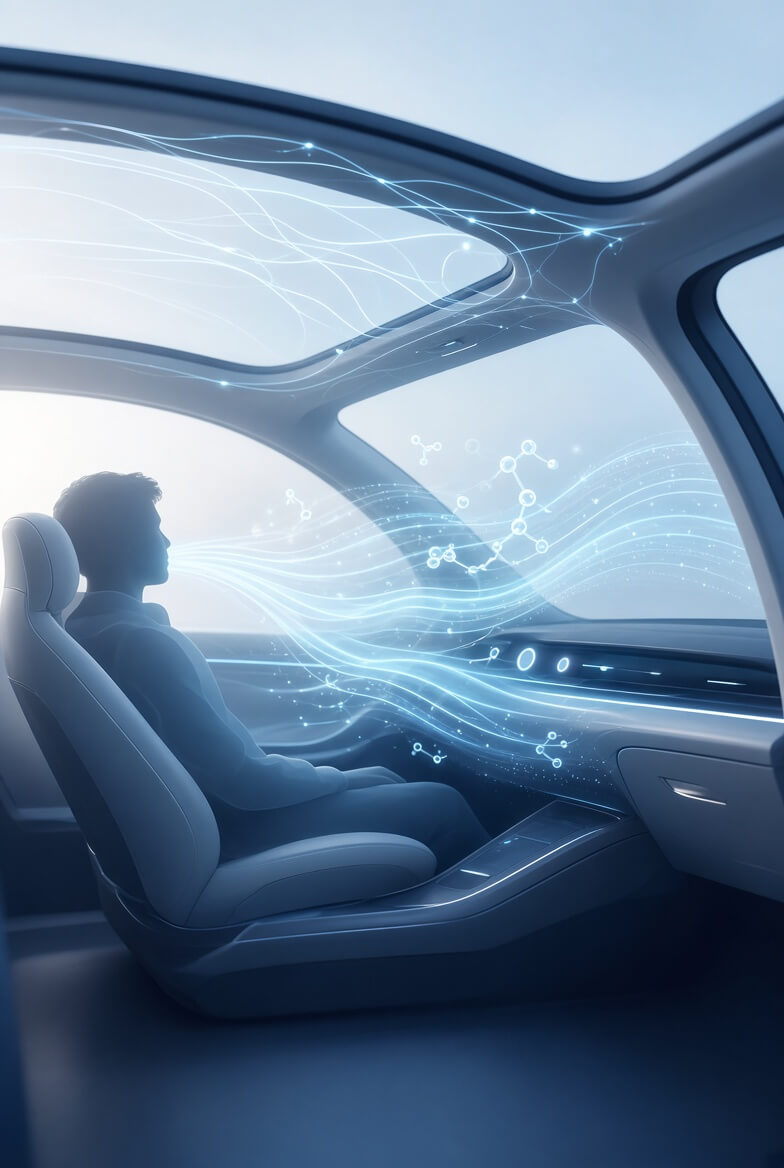
Few everyday environments reveal the gap between accidental and intentional scent more clearly than the modern shared vehicle. A passenger steps into an enclosed volume that has already been occupied, often by multiple previous riders. Residual odors—smoke, food, body chemistry, cleaning agents, the mixed and unpredictable chemistry of prior trips—hang in the air or adsorb onto surfaces. The journey itself may last only ten or twenty minutes, yet those minutes are spent inside a continuous physiological message that no one consciously chose and that the nervous system cannot fully ignore.
“The cabin that opens its doors is not conventionally perfumed. It is reset.”
A different design philosophy treats the cabin as a short, programmable interval rather than a passive container of residual air. When a ride is requested with a wellness orientation, preparation can begin before the passenger arrives. A natural scent technology is introduced that has been shown to reduce airborne viral load substantially—on the order of eighty-five percent under controlled cabin conditions. At the same time, residual odor molecules are addressed at the structural level: their chemistry is altered so that they no longer present as smell to the human nose. The cabin that opens its doors is not conventionally perfumed. It is reset.
The distinction is important. A heavily fragranced cabin may create an initial impression of freshness while leaving the underlying odor chemistry largely intact. A reset cabin has had that chemistry actively addressed. The air the passenger breathes is closer to neutral, and any subsequent regulatory compositions can operate without competing against a complex and uncontrolled background of prior signals.
Once inside, the passenger is offered a functional choice. One mode orients toward comfort and physiological down-regulation: softer sensory cues overall, a composition selected to support parasympathetic ease. The other orients toward clarity and readiness: brighter cues, a composition selected to support alert presence. In both cases the foundation remains the same—cleaner air and neutralized prior history. What differs is the direction in which the body is invited to move during the minutes of the journey.
The experience is kept deliberately modest. It does not present itself as a spa treatment or a clinical intervention. It does not demand focused attention, special ritual, or any particular belief on the part of the passenger. It simply uses the unavoidable minutes of transit to subtract physiological load rather than add to it. Before the ride, the passenger may have been carrying residual tension, cognitive residue from the previous interaction, or the low-grade stress of navigating a dense urban environment. By the time the doors open at the destination, a measurable shift has occurred. The air left behind was cleaner. The odors that would otherwise have been inherited are gone. Depending on the mode chosen, muscular tension is lower or attentional clarity is higher. The passenger steps onto the curb carrying less of what they brought into the vehicle and less of what previous occupants left behind.
“The cabin ceases to be a site of residual stress and becomes a brief, reliable instrument of recovery.”
Any single trip produces only a small difference. Multiplied across a week of commuting, a month of frequent travel, or a year of shared rides, the cumulative effect becomes significant. The cabin ceases to be a site of residual stress and becomes a brief, reliable instrument of recovery. In a world in which large numbers of people spend meaningful portions of their waking lives inside vehicles, that change in the character of the interval is not trivial.
6. Mode, Light, and Sound

Subtle layering of sensory cues so the body lands where it needs to be
Scent never operates in isolation. The same limbic and autonomic networks that respond to odor also respond to the intensity and spectral quality of light, to the rhythmic and harmonic properties of sound, and to the overall coherence or conflict of the sensory field as a whole. When these channels are deliberately coordinated, the regulatory effect compounds. When they are left to chance or allowed to conflict, the nervous system receives mixed messages and the intended effect is diluted or cancelled.
In vehicles and other spaces equipped for fuller multi-sensory design, the choice of mode therefore extends beyond the composition released into the air. Lighting can be shifted: warmer color temperatures and lower intensity for a relax trajectory, cleaner and brighter qualities for an alert trajectory. Audio can be selected according to the same intention—not merely preferred entertainment content, but curated material whose tempo, harmonic simplicity, dynamic range, and freedom from abrupt contrast support the desired physiological direction. The cabin becomes a brief, coherent multi-channel environment tuned to the passenger’s next need.
“Design that respects this ecology does not seek to overwhelm the senses; it seeks to align them.”
The governing principle is ecological. Living organisms evolved to read environments as integrated wholes rather than as collections of isolated sensory streams. A space that smells clean, appears calm, and sounds steady is more persuasive to the nervous system than any single channel working in isolation. Conversely, a space that offers a calming olfactory composition while bathing the occupant in harsh cool light and abrupt audio notifications is working against its own intention. Design that respects this ecology does not seek to overwhelm the senses; it seeks to align them. The occupant does not need to analyze the experience or decide to feel better. The body simply finds the regulated state easier to reach and to maintain.
A multi-sensory approach also offers practical robustness. Individual responses to particular scent compositions vary with personal history, cultural background, and momentary physiological state. Light and sound provide additional, partially independent levers that can reinforce the intended direction even when the olfactory channel is operating with a more universal or baseline composition. The combination is more reliable across a diverse population of users than any single modality alone.
The design challenge is one of restraint. It is easy to over-program an environment until it feels artificial, controlling, or thematically heavy-handed. The more successful implementations keep the sensory field coherent yet quiet. The goal is not to announce that a wellness system is operating. The goal is for the passenger or occupant to leave the space feeling that the interval was somehow easier, clearer, or more restorative than expected—often without being able to name precisely why.
7. Reading, Adapting, Restoring

Digital Scent AI and the shift from broadcast to conversation
Until quite recently, even relatively sophisticated scent delivery remained essentially a broadcast medium. A composition was selected, diffused at a predetermined intensity for a predetermined duration, and left to act on everyone present in the same way. The emerging horizon is conversational rather than broadcast. Sensors, accumulated preference and response data, contextual information, and adaptive algorithms begin to treat scent as a responsive environmental layer rather than a fixed setting.
Digital Scent AI does not invent the body’s responses; it observes and learns from patterns in how bodies actually respond across time and across populations. With sufficient data and appropriate safeguards, such systems can refine the timing, intensity, and compositional character of scent delivery, and can coordinate those adjustments with other sensory channels, according to what demonstrably supports a given person, a given time of day, or a given activity. The same underlying platform that prepares a cabin for sanitization and molecular odor control can, in richer deployments, begin to personalize the regulatory dimension—recognizing recurring patterns associated with stress, fatigue, or focused work and adjusting the sensory field in response.
The movement from broadcast to conversation raises both the potential benefit and the ethical stakes. Because the olfactory pathway operates largely below the threshold of ordinary conscious scrutiny, any system that shapes it inherits unusual influence over state. That influence must be matched by corresponding transparency of purpose and restraint in claim. The legitimate goal is not behavioral manipulation—steering people toward commercial or institutional outcomes they did not choose. The legitimate goal is restoration: using the direct anatomical line to help the body recover capacity, regulate arousal, and meet subsequent demands with more resource rather than less.
“…adaptive scent becomes one more instrument for environments that support human functioning instead of quietly taxing it.”
When that restorative orientation is held consistently, adaptive scent becomes one more instrument for environments that support human functioning instead of quietly taxing it. Reading without subsequent adaptation is little more than data collection. Adaptation without a restorative purpose is optimization in service of someone else’s metric. Restoration attempted without reading is generic and often ineffective guesswork. The three elements together describe a closed loop of care: the system takes in relevant signals, adjusts the sensory field in response, and does so in the service of the occupant’s continuing capacity.
A concise formulation has emerged that captures the aspiration. The system reads you. It adapts to you. It restores you. Each term is necessary; none is sufficient alone. Together they articulate not merely a product capability but a design philosophy for the next generation of olfactory and multi-sensory environments.
8. Intelligent Olfactory Environments
Homes, vehicles, and spaces that sense and respond
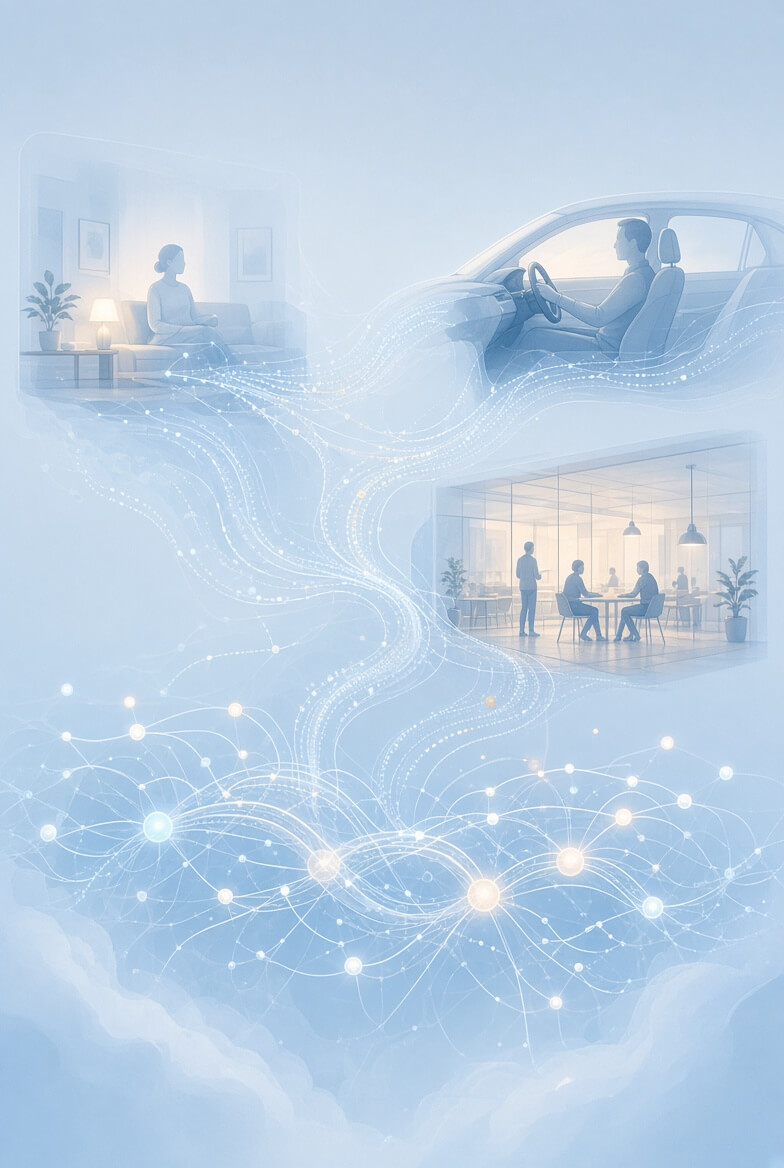
The vehicle cabin is only one instance of a broader pattern now becoming visible. Homes, workplaces, hospitality properties, clinical and educational settings are all beginning to treat scent as a controllable environmental variable rather than an incidental byproduct or a purely decorative afterthought. The governing principles remain consistent across scales: reduce biological and chemical residue in the air where possible; introduce compositions that support the intended physiological and emotional state of the people present; coordinate scent with light, sound, and schedule so that the overall sensory field is coherent rather than contradictory.
What changes as the scale expands is the density of data and the sophistication of the control layer. Connected platforms can learn patterns of occupancy, time-of-day needs, and—when consent and transparency are properly established—individual preferences and response histories. A bedroom can shift toward restorative compositions in the evening hours and toward gentle alertness in the morning. A meeting room can clear residual chemistry between successive groups so that each conversation begins from a cleaner baseline. A vehicle fleet can maintain a consistent standard of air quality while still offering mode choice to each rider. A hospitality property can treat the guest’s arrival not as the beginning of a static stay but as the opening of a continuous, quietly adaptive sensory conversation.
The enabling technologies for such environments are already largely available. Precise dry-air diffusion systems can introduce scent without wetting surfaces or producing heavy, lingering saturation. Modular cartridge architectures can keep sanitizing, odor-neutralizing, and regulatory mood functions separate so that each can be deployed according to actual need. Software layers can orchestrate release according to occupancy sensing, calendar context, or explicit user preference. What remains comparatively scarce is the design discipline that treats scent with the same seriousness already accorded to temperature, lighting, and acoustics—as an environmental parameter that shapes human experience whether or not anyone is paying conscious attention to it.
The cultural and institutional shift may prove more demanding than the technical one. Most people, when they think about scent at all, still classify it as a matter of personal taste or decorative flourish. Moving it into the category of infrastructure requires demonstration, education, and a growing track record of quiet, reliable benefit. The environments that succeed will be those in which the advantage is felt before the underlying technology is named or marketed.
9. The Future of Scent

What comes next for the oldest sense in a digital world
The overall trajectory is already visible even if the precise timetable remains uncertain. Scent is migrating from a largely passive, poorly controlled, and frequently accidental feature of human environments into a designed, measurable, and increasingly adaptive layer of everyday experience. The relevant question is no longer whether this transition will occur, but how thoughtfully it will be guided and how equitably its benefits will be distributed.
In the near term, the most consequential advances are likely to remain practical and incremental. Improved methods of molecular odor control will make shared spaces genuinely neutral rather than merely masked. More precise and reliable sanitizing compositions will reduce biological load in vehicles, clinics, schools, and high-traffic interiors. Mode-based regulatory scent, coordinated with light and sound, will move from early deployments into wider mobility, hospitality, and workplace settings. Each of these steps is modest in isolation; together they alter the baseline quality of the air that large numbers of people breathe for significant portions of their lives.
Further ahead, personalization will deepen. Environmental and, in some cases, wearable sensors capable of tracking relevant physiological or behavioral signals will allow systems to adjust olfactory and multi-sensory fields with greater temporal precision. Privacy, consent, and governance frameworks will need to develop in parallel; the same anatomical directness that gives scent its power also makes careless or opaque use particularly problematic. The platforms that earn lasting trust will be those that are clear about what they sense, what actions they take, and in whose interest those actions are taken.
Clinical and high-performance applications will continue to investigate the speed and specificity of the nasal and olfactory routes. Research into inhaled compounds—including, in carefully controlled research settings, certain psychedelic and other neuroactive agents—may open new therapeutic options for conditions that have responded poorly to slower systemic pathways. In parallel, non-pharmacological uses of functional scent for attentional focus, physiological recovery, and state regulation will expand in athletic, operational, and knowledge-work contexts.
“Scent may come to be taught, specified, and regulated more like lighting or acoustics”
At the level of culture and professional practice, a larger conceptual shift is possible. Scent may come to be taught, specified, and regulated more like lighting or acoustics—as an environmental parameter with documented effects on human function and well-being. Architects, interior designers, fleet operators, product teams, and facilities managers will include olfactory strategy in their briefs as a matter of course. Occupants and consumers will begin to expect that the air of the spaces they enter has been considered rather than left to chance or to the lowest common denominator of residual chemistry.
None of these developments requires any alteration of human biology. The direct line from the nose to limbic and autonomic systems is an evolutionary inheritance that will remain. What can change is the degree to which the environments we design finally take that inheritance into account. The future of scent is not a future in which the body is rewritten. It is a future in which the spaces we inhabit stop ignoring the body and start working with it.
The oldest sense is becoming newly visible to technology and to design. The work of the coming decades is to ensure that this visibility is translated into care—into environments that reliably subtract unnecessary load, support recovery, and meet the nervous system where it already is, without demanding continuous conscious effort for every small act of restoration.
FINAL THOUGHTS
The body does not wait for permission. That is not a slogan; it is a description of neural architecture. Molecules arrive at the receptors, signals travel the short path, limbic and autonomic systems move, and only later—if at all—does conscious narrative catch up and attempt to explain what has already occurred.
For most of recorded history we have lived inside that fact without systematically designing for it. We have accepted the accidental chemistry of shared air, the residual stress of transit, the random emotional coloring of whatever happened to be present in the room. The opportunity available now is different. We can clean the air of what does not belong in it. We can introduce compositions that support the physiological and emotional states people actually need. We can coordinate scent with light and sound so that short intervals become restorative rather than depleting. And we can begin to build systems that learn, carefully and with appropriate transparency, how to meet each person where their nervous system already is.
None of this requires the body to change its fundamental wiring. It requires only that we stop treating the direct line as an afterthought or a curiosity. When we do, the minutes between one place and the next stop being empty or residual. They become part of how we take care of ourselves—and of one another—without demanding conscious effort for every small act of recovery.
Reads you. Adapts to you. Restores you.
— Keith Kelsen
Selected Bibliography
The following sources informed the scientific and technological framing of this work. They are listed for readers who wish to explore the underlying research and related literature.
Bratman, G. N., et al. (2024). Nature and human well-being: The olfactory pathway. Science Advances.
Kontaris, I., et al. (2020). Behavioral and neurobiological convergence of odor, mood and emotion. Frontiers in Behavioral Neuroscience.
Masuo, Y., et al. (2021). Smell and stress response in the brain: Review of the potential involvement of the olfactory system in stress.
Sullivan, R. M., et al. (2015). Olfactory memory networks: from emotional learning to social behaviors. Frontiers in Behavioral Neuroscience.
Additional technical and experiential writing on digital scent platforms, cabin air-quality interventions, molecular odor control, dry-air diffusion systems, and functional fragrance applications appears across industry and scientific venues.
Keith Kelsen’s Blog 2017-2026 Keith Kelsen’s The Scent Narrative