
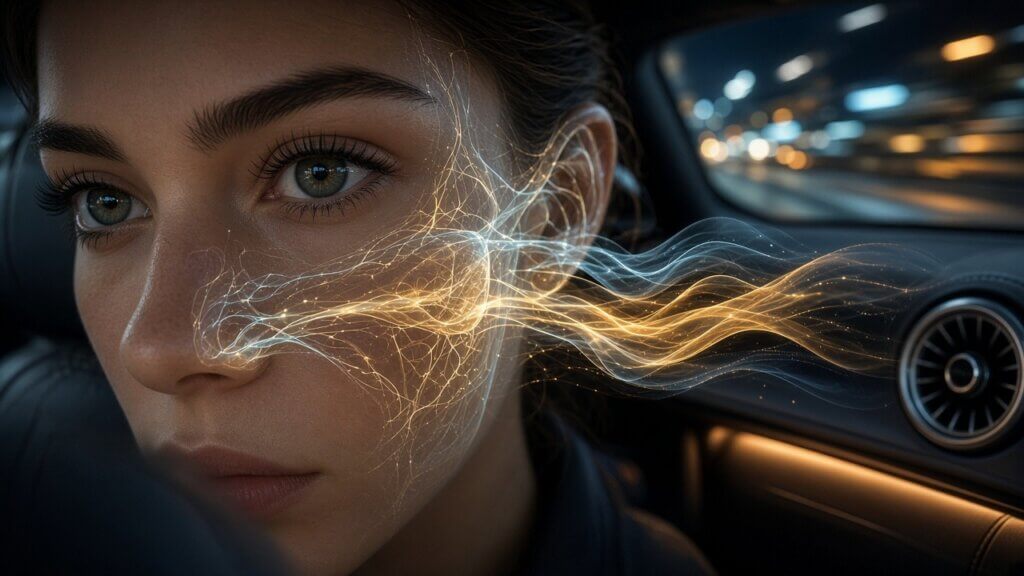
Motion sickness isn’t drama. It’s a conflict — eyes on a screen, cabin accelerating, vestibular system voting no.
As cars get more autonomous, that conflict shows up more often, not less.
You’re already in the rear seat. Phone in hand, checking texts and emails. Gazing down. The hillside road outside keeps turning — 10 turns, up and down in the city of San Francisco with extreme hills, as if this were the Laguna Seca racetrack course — and your inner ear keeps filing bad reports your eyes refuse to open. Shoulders tighten, sweaty palms, and your stomach votes next. The cabin didn’t do anything wrong. Your senses are in the boxing ring and it’s a draw with solid punches coming from both.
Eyes still. Body moving.
Your brain builds motion from eyes, inner ears, muscles, joints. When the screen says you are sitting still and the vestibular system says the car is climbing, banked, and turning, the mismatch can read like a poison alarm. Nausea isn’t theater. It’s an ancient fail-safe. UMTRI and University of Michigan work put numbers on how common that fail-safe is: about 33% of people experience motion sickness in mild or autonomous-vehicle contexts, and unchecked, about 22% would vomit. An international survey of roughly 4,479 adults (Schmidt, Kuiper, Wolter, Diels, Bos) found about 46% had carsickness as a passenger in the past five years — about 59% lifetime, including childhood. Driving dynamics, visual tasks, and low air quality make it worse. Self-driving cabins raise the risk further: everyone becomes a passenger, anticipation and control fall away, and reading or screens deepen the conflict. That is the ride you booked when you looked down.
Smell arrives before the argument finishes.
In about 100 to 150 milliseconds, odor molecules hit the olfactory path, skip the long briefing, and start shaping how the cabin feels — cooler, smoother, more usable — before you’ve decided the curve was “a lot.” Functional scent is not perfume over a queasy seat. It is another channel into a conflict already underway.
Motion Relief meets the curve
In June and July 2018, an Inhalio–IFF Motion Scent Test put that idea on a real road near Saratoga, California. Subjects sat as rear passengers, reading on an iPad Mini with a downward gaze. The course was extreme: about nine minutes, roughly fifty-four curves on a curvy hillside loop. A proprietary scent mix moved through the cabin by dry-air polymer diffusion, driven by Inhalio software designed to dose the space without flooding it. Talkable notes of scent for settling digestive signal and blood pressure, scent to easing nausea and relaxing that tight, cramping stomach feel, and scent that focuses the mind- keeping you alert and sharp.
Mild-to-medium sensitivity riders showed clear gains with scent: lower sickness ratings, faster recovery after the run, and a car that felt “better,” cooler, smoother — even when temperature and vehicle were unchanged. Extreme sensitivity was harder. Symptoms still arrived, though often delayed by up to about two minutes and less extreme; overall improvement was clear. Women, in their notes, found the scent more effective than men. Across all riders, recovery times improved with scent, and the cabin itself seemed nicer when the air was working.
Sanitize. Neutralize. Adapt.
First the cabin has to stop adding noise — stale air, leftover odor, the chemical clutter that makes a closed box feel hotter than it is. Then neutralize what’s left so the next note can land clean. Then adapt: deploy Motion Relief when the body is in that eyes-versus-ear fight, so the ride can stay usable while you read, ride, or wait for autonomy to finish the turn.
You don’t need a lecture on sensory conflict to know the moment. Chin down. Phone screen bright. Road moving under you. The question is whether the cabin only carries the conflict — or whether it can answer it.
Reads You. Adapts to You. Restores You.