
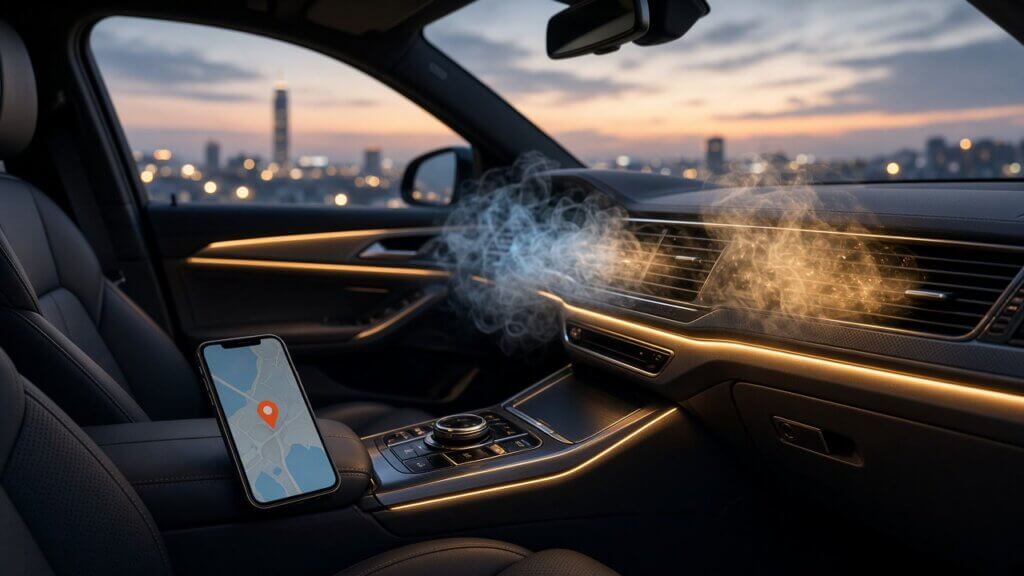
You open the rideshare app. Pickup in four. Same blue pin. Same car class. You tap Book and the map starts moving.
You booked the ride. You didn’t book the air.
Whoever got out three minutes ago left more than a crumpled receipt. Smoke in the headliner. Takeout in the seatback. A body that ran hard and then sat still. The cabin is already running last passenger’s air through your next ten minutes. None of it asks if you want the briefing. It just arrives.
Your body gets the message first.
Before you’ve closed the door, the air has already reached the nose, skipped the thalamus, and started moving mood, memory, and alertness. About 100 to 150 milliseconds. You didn’t decide the car felt “off.” The architecture of smell doesn’t wait for permission. The app cleared the last trip. It did not clear the cabin.
Chemical storm vs. backseat B.O.
This isn’t just your ride. On September 11, the Wall Street Journal’s Joseph Pisani put a name on it: Chemical Storm vs. Backseat B.O. — the fight over Uber and Lyft air fresheners. Trees. Vent clips. Seven hanging from the mirror. Riders calling it aggressively fresh, then posting about headaches and dizziness. Petitions for fragrance-free. Uber saying they’d rather you remember the trip, not the freshener. Lyft telling drivers windows and odor absorbers, not fragrance — and riders still finding trees. Drivers, stuck between fares, fighting smoke, vomit, and food the only way they know: more perfume.
Both sides are describing the same closed box. One side is drowning last passenger’s air. The other is drowning it in perfume.
Neither is a reset. Covering it doesn’t change the last passenger
A shared car turns over all day. People eat in it. Argue in it. Recover in it. Then the next pin drops. Wiping the cup holder is not a new cabin. It is the last trip wearing a different shirt. Smoke. Body odor. Food. Those molecules are still in the fabric and the vents. Your nose still finds them. So does the rest of you.
Functional scent works differently.
First it can help clean the air — natural compositions designed to reduce what you don’t want floating through a closed space. Then it goes after leftover odor the way a real cabin reset does: not by burying it in perfume, but by changing the molecular structure of the odor itself. Neutral. Not covered. Gone enough that the ride can start over.
That is the difference between decoration and work.
The trip has a job
A cabin is not one mood. You didn’t book a spa. You booked A to B — Comfort/Relax when the world needs to quiet down, Rejuvenate/Alert when the next stop won’t wait. Spraying the same note for every rider is like leaving the overhead lights on high all day and calling it service.
A Wellness Ride reads the interval you’re actually in. Quiet: air cleaned, leftover odor dismantled, then a functional note that matches what the body needs next.
When a cabin can sanitize, neutralize, and then adapt, the car stops being a storage unit for whoever rode last. It becomes a short reset between one version of you and the next.
The air is already speaking
You don’t have to believe any of this for it to be true. Climb into a car the app called ready and notice what happens in the first few seconds. Shoulders. Breath. Attention. The story you tell yourself comes later. The body already voted.
It isn’t background. It’s a medium. And most rides that say booked are still broadcasting the last passenger — or the tree that tried to cover them.
They don’t have to.
Reads You. Adapts to You. Restores You.