
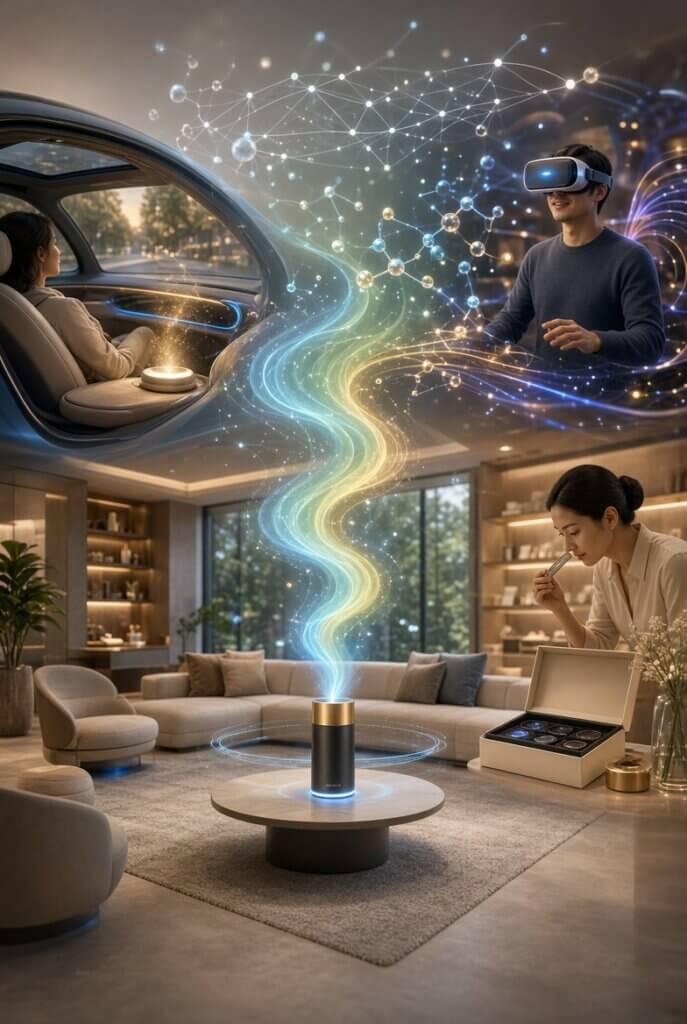
For smart homes, mobility, and consumer experiences the changes will be centered on wellness.
AI-driven sensory technologies—particularly digital scent systems like the one Inhalio is developing—will become a foundational layer in how environments sense, respond to, and influence people. Here’s how this plays out across smart homes, mobility, and broader consumer experiences:
1. Smart Homes
Scent will evolve from a passive fragrance into an active, AI-orchestrated sensory interface.
- Context-aware atmospheres: AI will continuously read signals (time of day, occupancy, biometric data from wearables, voice tone, activity patterns) and dynamically adjust scent profiles. Morning alertness scents, evening wind-down blends, or focus-enhancing notes during work hours will run automatically.
- Wellness and health integration: Homes will use targeted scent delivery for sleep optimization, stress reduction, air-quality perception, and even subtle therapeutic support—tightly coordinated with lighting, temperature, and air purification systems.
- Immersive entertainment & daily rituals: Movies, music, cooking, or meditation sessions will include synchronized scent layers. The home becomes a multi-sensory stage rather than just a collection of connected devices.
- Inhalio’s role: As an integrated system, it turns scent into a controllable, programmable layer that sits alongside voice assistants, lighting, and HVAC—making the home feel more alive and responsive.
2. Mobility
Vehicles (especially premium and autonomous ones) will treat the cabin as a personal sensory environment.
- Driver state management: AI will detect fatigue, stress, or distraction and release targeted scents to promote alertness or calm—complementing existing safety systems.
- Personalization at scale: Each occupant can have a preferred scent profile that activates when they enter the vehicle. Family members, rideshare passengers, or fleet users experience different atmospheres without manual adjustment.
- Brand and emotional differentiation: OEMs will use signature scent experiences as a new form of brand identity and customer loyalty, especially as vehicles become software-defined and shared.
- Autonomous and shared mobility: When cars become living rooms on wheels, multi-sensory comfort (including scent) becomes a key differentiator for time spent inside the vehicle.
3. Consumer Experiences
Scent will move from marketing gimmick to core part of product and service design.
- Retail & e-commerce: Physical stores will create dynamic scent journeys that change by zone, time, or customer profile. Online, digital scent hardware will eventually let consumers “sample” products remotely or receive scent-enhanced unboxing experiences.
- Entertainment, gaming & VR/AR: Fully immersive experiences will incorporate scent as a standard sensory channel, increasing emotional engagement and memory formation.
- Personal devices & wearables: Smaller, AI-controlled scent modules could appear in headphones, AR glasses, or personal air devices, delivering micro-doses of scent tied to notifications, mood, or location.
- Data-driven personalization: AI models will learn individual scent preferences and physiological responses over time, creating highly individualized sensory profiles that travel across home, car, and public spaces.
Overall Trajectory
AI-driven sensory technologies will shift environments from reactive to anticipatory. Instead of users manually selecting a scent, the system will infer intent and emotional state and respond in real time. Digital scent platforms like Inhalio’s become the delivery infrastructure that makes this possible—turning scent into a software-defined, networkable, and measurable sensory medium.
In short: smart homes will feel more human, vehicles will feel more personal, and everyday consumer experiences will gain a powerful new emotional dimension that sight and sound alone cannot provide.