
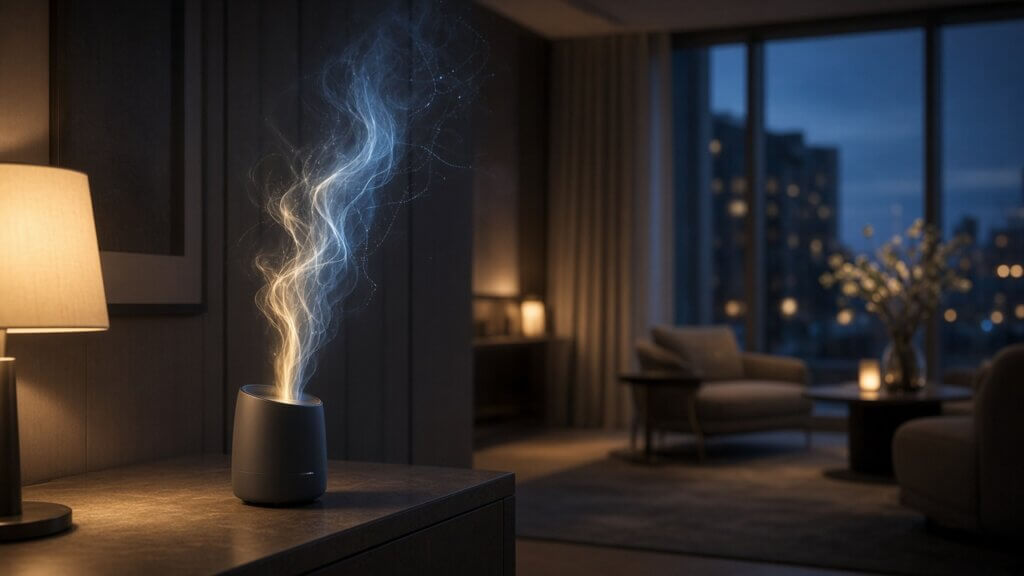
You feel it before you can name it.
The rideshare door closes and the cabin is already settled. The hotel key turns and the room meets you clean. You walk into your own house and the air does not still belong to this morning. Three places. One sensation. Something in the air has already decided how the next hour will go.
That is the speed of scent. Smell arrives in roughly 100 to 150 milliseconds, and the olfactory path skips the long thalamic briefing every other sense has to sit through. It goes straight to emotion and memory. By the time you think about the room, the room has already decided how you feel.
First, the Air Gets Clean
Every good experience starts with nothing in the way. Before a fragrance can mean anything, the space has to be sanitized. The last passenger in the rideshare. Checkout in the hotel. The day still hanging in the house. Residue, trace, stale recycled air, cleared out. You never notice this step when it is done well. You only notice when it is skipped.
Then, the Noise Goes Quiet
Clean is not the same as neutral. A cabin collects the ride before yours. A corridor collects every door that opened. A kitchen collects dinner. Those stories compete with whatever you are meant to feel. Neutralizing takes the competing notes down to silence, so a scent can land clearly, the way a single voice carries in a quiet hall.
Now, the Room Answers Back
A morning commute is not a late checkout, and neither is home after dinner. Adaptive scent shifts with the hour, the occupancy, the season, the mood a space is meant to hold. Bright and clarifying when you need to arrive. Soft and grounding when you need to come down. You do not see the change. You feel that the place seems to know you.
What You Felt Is What Got Measured
Here is the part you never see, and it is the point. The unit in the cabin, the unit in the suite, the unit at home: none of them is a local guess. Each is one node in a worldwide read. The Digital Scent AI Platform collects what each connected cartridge is doing — how full it is, how hard it runs, what the room around it is doing — wherever those units sit. Country by country. Property by property. Ride by ride. The quiet moment you had is not a lucky accident in one lobby. It is a reading, taken again and again, across the world.
The analysis does not stop at the box on the wall. It goes down to the ingredient. Not “it smelled fine.” Which notes were in the air. How they were dosing. What the cartridge still holds. A scent stops being a mood someone hoped for and becomes a composition you can actually see.
Then it aggregates. Many countries. Many cartridges. One picture. A single unit can tell you about one room. The platform tells you what is happening across the world: where an ingredient is carrying the experience, where a cartridge is thinning, where the air people feel and the air the system records have started to drift. The pattern is the point. Within five years, 10 million cartridges could be giving us real insight into human interaction with scent.
All of it lands in one place. Rideshare, hotel, and home, rolled into a single dashboard: decisions made, predictions adjusted, ingredients changed. Not three anecdotes. One read of what the air did, and what it should do next.
The payoff is not the screen. It is the person you meet after. Better air, chosen from the data, changes how you arrive — calmer in the car, welcomed at the desk, yourself when you walk in the door at home.
The interaction gets better because the air already did the quiet work. You felt it. The platform measured it. The next conversation starts from here.
Reads You. Adapts to You. Restores You.