
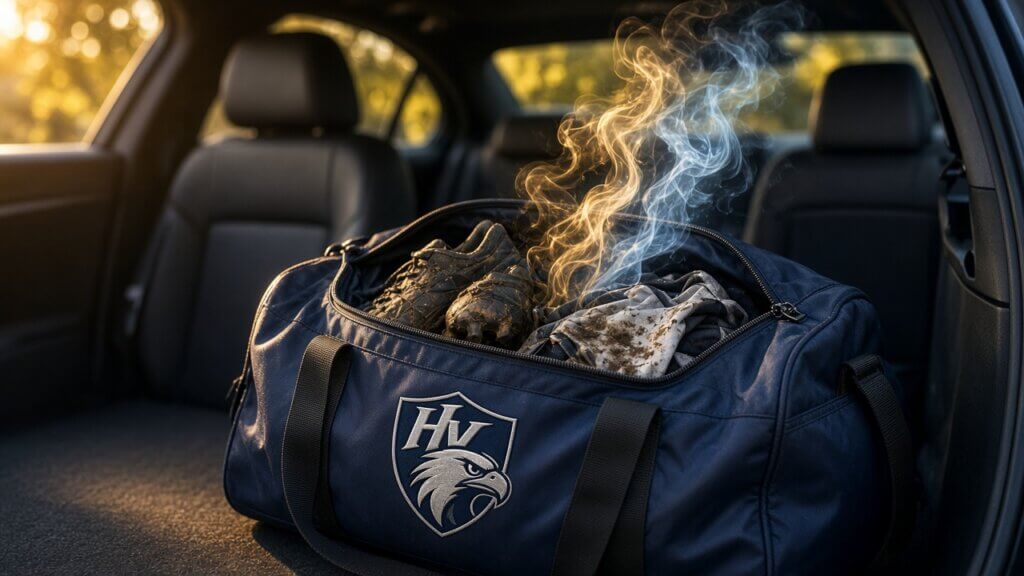
You pop the hatch at 6:40 on a Saturday evening, and the car exhales before you do.
It is not loud at first, just a warm, sour thread rising off the duffel your kid tossed in after practice, the one with the zipper that never quite closes. Cleats knotted by their laces. A jersey balled into a fist. Shin guards that have been marinating in sweat, sunscreen, and cut grass for six hours in a parked car.
Practice ended at noon. The bag did not get the memo.
You lean in for the water bottle and catch the full chord: damp foam, wet nylon, that faint ammonia edge every parent of a teenager knows by its official name. Pee-u. Locker-room funk with a learner’s permit. And here is the part that stings: you closed the hatch hours ago, but the cabin has been holding onto every note of it.
The Bag Rides Up Front
It does not stay in the cargo area. It never does. By Monday morning, the smell has climbed over the seatbacks and into the headliner, the floor mats, the fabric of the driver’s seat where you sit with your coffee. You crack a window and it lingers. You hang an air freshener and now it is practice plus pine, which is somehow worse.
Your nose registers it in roughly 100 to 150 milliseconds, faster than you can decide whether to care. Smell is the one sense that skips the long briefing in the thalamus and goes almost straight to the brain’s emotion and memory centers. That is why one breath of damp gear can put you back on a cold bleacher in October, or back in your own high school locker room, before your thinking mind has even found its keys. The cabin is not just storing an odor. It is storing a mood, and replaying it every time you open the door.
Sanitize, Then Neutralize
Masking will not hold. Funk like this is alive in the most literal sense: bacteria feeding on sweat in warm, closed fabric, releasing the compounds you are smelling. Covering it with fragrance just layers a performance over a problem.
The real reset starts where the smell starts. The Malodor cartridge will sanitize the air moving through the cabin so the source stops getting a vote. It will neutralize what has already settled in, breaking down the sour molecules instead of perfuming over them. No cloud of synthetic citrus. No headache by the second stoplight. Just the absence of Saturday, which turns out to be its own kind of luxury.
Air That Learns Your Week
Then the cabin does something a can of spray never could. It adapts. It notices when the hatch opens on a Tuesday and the bag comes back, still damp from a scrimmage. It notices that the after-school run is the hard one: windows up, heat on, four teenagers and their gear packed shoulder to shoulder. It responds before you have to ask.
The goal is not a sterile car. The goal is usable air. Air you can actually breathe on the drive to work after drop-off. Air that lets your kid climb in muddy and loud and starving, and still lets you start the next morning clean.
The Cabin Gets the Last Word
Practice will happen again next weekend. The bag will come home heavier, wetter, and more ambitious than before. That is the job of a teenager’s sports bag.
The job of your cabin is to quietly win the rematch. To clear what rode home, restore what you breathe, and hand you back a car that smells like nothing at all, which is to say, like yours.
Reads You. Adapts to You. Restores You.